
With more students in Oakland, universities and developers are working to With more students in Oakland, universities and developers are working to meet the growing demand for housing. meet the growing demand for housing.
The race goes on at the University of Pittsburgh between adding students and establishing places for them to live, with huge impacts for all of Oakland and its tight residential market. Over the past decade, Pitt has grown its total student headcount — including both graduate and undergraduate students — at its Oakland campus from 28,664 in fall 2016 to 31,237 in fall 2025 — a 9% increase. A significant chunk of that increase has come in the past year alone, with enrollment up 4% between fall 2024 and 2025 as Pitt welcomed its largest class ever of firstyear students, totaling 5,870.
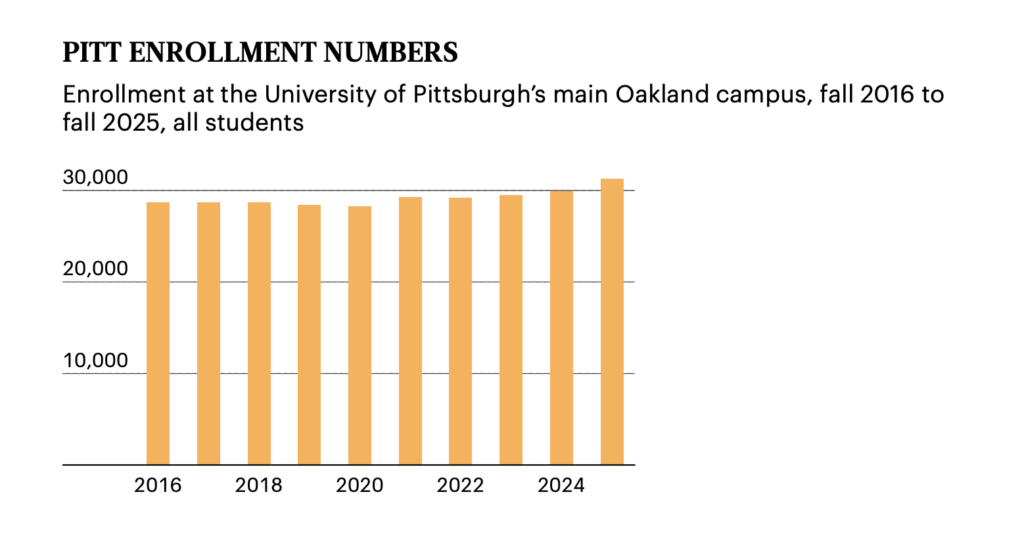
Yet with this rise, it begs the question: Where are all of these students going to live in an Oakland that’s already facing a housing shortage?
Working to find more housing for students
At Pitt, work is underway to tackle this challenge.
The university has specified housing goals for itself, both in its Institutional Master Plan (IMP), a planning document reviewed, approved and registered with the city, as well as in its own Campus Master Plan, first implemented in 2019 and updated last year. In its 2021 IMP, Pitt committed to the city to deliver 1,400 new residential beds by 2031, and its revised Campus Master Plan from last year quoted other university planning efforts to raise on-campus residency for its students from 41% to 60%, acknowledging how “enrollment growth has strained Pitt’s threeyear (now two-year) housing guarantee, leading to increased density, removal of lounge spaces and leasing of non-university owned housing” and further noting that “there is a significant unmet demand for on-campus student housing.”

including Pitt’s Litchfield Towers A and B (with signage peeking between) and Brackenridge Hall
and Bruce Hall in the foreground.
In response to questions about its efforts to meet that demand, the university provided a written response emphasizing an all-of-the-above approach: “To meet the strong demand for a University of Pittsburgh education, the university is considering a series of short- and long-term housing solutions, including leasing additional space, repurposing existing campus buildings, acquiring new properties and constructing new facilities. This will allow the university to address immediate needs while planning for the future.”
In a Q&A response for an upcoming Oakland Corridors of Opportunity to be hosted by the Pittsburgh Business Times, Kevin Washo, senior vice chancellor for external relations at Pitt, further explained the broader approach of how the university thinks about future housing options in Oakland while balancing affordability, density and community needs.
“Universities are no longer the sole provider of student housing, with publicprivate partnerships and private development shaping the broader market,” he wrote. “At Pitt, we focus our investments on delivering high-quality, competitively priced housing that reflects how students live and learn today. That includes a range of housing types, such as suite-style and apartmentstyle living, spaces that foster social connection and proximity to key academic building clusters that support students’ daily experience. For example, our new 400-bed, first-year housing development is adjacent to our music, computing and biological sciences buildings and has extraordinary walkability to Craig Street, the Cathedral of Learning, the William Pitt Union and the new Recreation and Wellness Center.”
That new housing development will be Pitt’s first ground-up residential project since it opened Nordenberg Hall on Fifth Avenue in 2013.
A project announced in early May after it was approved by Pitt’s Board of Trustees, the plan calls for building a nine-story residence hall onto what’s currently 30 surface parking spaces that wrap around the music building along Bellefield, Ruskin and Fifth avenues in Oakland.

Pitt will need approval from the Pittsburgh Zoning Board of Adjustment to build the residence hall on a site owned by the university in an education/medical institutional (EMI) zoning district intended to enable university expansion.
“As a dormitory is only allowed in EMI, and it’s only allowed by special exception, at least my expectation is that this is something that would be supported by the zoning board of appeals and by the community,” Gina Bleck, vice chancellor for planning, design and construction at Pitt, said at a recent Development Activities Meeting.
The university also has focused on adding more beds and residential units to its established facilities, as well as buying and leasing residential properties in the neighboring community.
“The Plan for Pitt and the housing strategic plan aspire to raise undergraduate student residency rates, and the Campus Master Plan identifies specific sites for near-term and long-term housing development to achieve that goal,” the university stated. “For immediate needs, departments across the university are partnering to create solutions to accommodate the incoming first-year class and the two-year housing guarantee. The new residence hall at Fifth and Ruskin avenues, which will add over 400 beds, is in addition to the 81 beds added several years ago at University Hall and the nearly 200 permanent beds that we added to our current housing portfolio last summer.”
In addition, Pitt housed around 250 students at a Hampton Inn near UPMC Magee-Womens Hospital as a short-term solution. It hopes to house students there again next year, although the Pittsburgh Zoning Administrator recently ruled that the use of rooms within a hotel for student housing is a dormitory use. Pitt plans to appeal this decision, according to the Zoning Board of Adjustment hearing agenda for June 4.
“Pitt’s use of the Hampton Inn is a short-term temporary arrangement while the university explores long-term housing solutions,” a university spokesman said in a statement. “The university is currently evaluating the number of students that may be placed at the Hampton Inn for the upcoming academic year.”
The ‘spillover of student housing’
Yet, the lack of new housing development at Pitt has led Pittsburgh City Councilperson Bob Charland, whose District 3 extends into South and Central Oakland, to compare Pitt’s approach to two of the city’s other major universities: Carnegie Mellon University and Duquesne University.
“The University of Pittsburgh has a very different philosophy for housing than CMU or Duquesne,” said Charland, who also is newly appointed to the Pittsburgh Planning Commission and a board member of the Urban Redevelopment Authority of Pittsburgh.
Both much smaller schools in terms of student population, and also private compared to Pitt as an institution that relies on state funding, CMU built two new housing projects adding about 530 new beds a little more than five years ago, and Duquesne opened its 556-bed McGinley Hall on Forbes Avenue in 2024.
By contrast, Charland said, “it seems like (Pitt’s) strategy is to let the private market build the housing that we need,” and to “let the developers solve the problem there.”
Charland noted how Pitt’s lack of new housing development impacts his district’s portions of the neighborhood, not only in some major multifamily projects cropping up, but also it “creates a situation where the university has less control over the housing supply.”
“The other thing that I would say is also with the university not working to build housing while increasing enrollment, you’re seeing more spillover of student housing into neighboring areas and further into South Oakland that used to be long-term residential,” he added.
Andrea Boykowycz, executive director of Oakland Planning and Development Corp., maintains the issue of the university externalizing its housing needs on its surrounding neighborhoods has been years in the making beyond its enrollment surge of recent years.
“You know, there’s only so much Oakland,” she said. “It’s at the point at which that pattern and set of expectations and assumptions has a very noticeable, negative impact on the community that it cannot sustain any longer. And I think we’re getting there.”
Boykowcyz has spoken about an inverted form of gentrification in her Oakland neighborhoods, recalling how a student intern lived in a house for which the rent was $4,200 a month, resulting in five other student residents joining in to help pay the outsized bill, a local student economy that mostly supports pizza shops and beer sales.
Erika Strassburger, a city councilperson whose East End District 8 includes much of the university’s campus, also noted the issue of Pitt and other college students living in rental housing in Central and South Oakland that can be unsafe and unsanitary as too many students pursue too few places to live.
“It is the No. 1 thing that we hear from neighbors,” she said. “I know the university cares about it. I know neighbors care about it. I know long-term residents care about it. The community groups certainly care about it to the extent that OPDC has a whole subcommittee that meets monthly just on code enforcement and how we can keep property owners maintaining their properties.”
Strassburger expressed the broad hope for the city to upgrade its zoning code to help accelerate new residential housing development in Oakland and citywide, which would enable Pitt to more easily add to its housing inventory.
“There’s no one living next to Forbes and Fifth, for the most part, who is saying, ‘if you build this tall building, you’re gonna create a shadow over my single-family home,’” she said. “That’s just not the problem there, where you might find it out in other parts of Oakland.”
She contrasted the “carrot” of allowing greater density in those blocks of central Oakland that are closest to Forbes Avenue with the need of a “stick” of a long-delayed and contrasted rental registration law that would enable the city to inspect the health and safety of apartments in the community.
What residential projects are coming
To be sure, there are some big residential projects in the works in Oakland that are being built by private developers and could help to alleviate the housing shortages.
In North Oakland along a stretch of Melwood Avenue, Hermitage-based Hudson Companies last year opened its 10-story, 148-unit high-rise called The Julian and is now working to build a companion 12-story project called The Parker next door, as well as Parker @ 450, an apartment complex with commercial and parking at 450 Melwood Ave.
Tyler Hudson, a partner at Hudson Companies, said that The Julian, which was completed in May 2025, is currently leased up “and continues to lease to not only students and graduate students but professionals desiring the North Oakland area, given its medical and university proximity.”
He further noted that The Parker’s vertical construction is planned to start in the fourth quarter, and Parker @450 is on track to be completed by August.
It’s a stretch of North Oakland in which Sterling Land Co. also completed a full renovation of its 81-unit Wellington Apartments, a nine-story apartment building, about a year ago and recently opted to master lease it to Pitt for use as student housing starting in August. It’s a move that Blake Stanton, copresident of the company, acknowledged marked the first time the familyowned company agreed to such an arrangement with the university.
Knowing the Oakland neighborhood well given Sterling Land’s various holdings there, Stanton expects Pitt faces as much of a challenge to add new housing there as anyone else.
“They’re not immune to the cost challenges that a developer would face,” he said of the escalating price tags for such projects. “The cost constraints are staggering. Then you’ve also got the challenges of the city and zoning and getting a building out of the ground.”
In central Oakland, Walnut Capital is well out of the ground on its 11-story project at 256 McKee Place, now called the Caroline at University Commons, expected to open by the fall of 2027 and total 480 beds in 160 units as a student housing project.
Todd Reidbord, president and a founding partner of Walnut Capital, said it’s the kind of project that includes more amenities, including “the largest fitness facility we’ve ever built.”
Still to get started is Philadelphia-based Radnor Property Group’s redevelopment of Pitt’s former Quality Inn site at 3401 Boulevard of the Allies, slated to be replaced by upwards of 240 to 260 apartments along with a grocery store.
And on Halket Street, Indiana-based Trinitas Ventures expects to close soon on financing and on the property so it can start construction this year on a 13-story multifamily redevelopment expected to add 326 apartments, a proposal approved by the planning commission last September.
Matt Klinzing, director of development operations for Trinitas and a Pittsburgh native whose father worked in Pitt’s administration, detailed the persistence required to be able to deal with multiple property owners to cobble together often limited sites on which to build projects such as the one Trinitas is pursuing.
He views Pitt’s challenge to add more housing of its own through a similar lens, describing the “very landlocked, very dense” neighborhood of Oakland, one in which UPMC also makes claims for space and housing demands for its employees.
“There’s obviously urban campuses everywhere, but I do think being in the heart of Oakland and how dense it is in particular just makes it very challenging,” he said.
As far as how Pitt is handling the housing needs stemming from its enrollment surge, Reidbord, a Pitt law school grad, emphasized the more the better.
“We’re all in on Pitt. It is the hottest university right now, probably in the state of Pennsylvania, if not in the Northeast,” he said. “They’ve really upped their game, and we’re riding those coattails and we’re really all supportive of it, and we want them to continue. I mean, for Pittsburgh, we need more people here. We need more students, we need more professors, we need more of everybody.”